Showing posts with label AC45. Show all posts

Thursday, June 16, 2011

Still Pinching Myself...

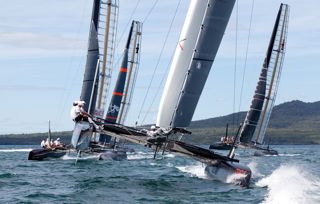
Yesterday I spent some 45 minutes sailing around the future racecourse area for the 34th America’s Cup on an AC45.

Yes, it happened, I was there, and I’m still reeling from the combination of incredible good fortunate to have had the opportunity and the adrenalin rush of pure unadulterated speed. My head is overcrowded with clichés as I try to relive that once in a lifetime experience (see, there I go).

Oh, and did I mention that it was all the more sweet with Russell helming for the first time since his spectacular capsize on Monday, although, I’ll admit to a moment of anxiety when Philippe Presti switched out and Russell jumped on board - the old adage about getting back on the horse came to mind as did Russell’s comments at the earlier press conference that it could take a few more bad decisions to get it right…

When the new Cup regime talked about accessibility, it never occurred to me that would include a Guest Racer Program that actually got folks with a huge range of sailing - or not - experience out on the actual boats that the teams race, particularly this early on in the action. It's almost unprecedented in Cup history, with the exception of the previous highly coveted 17th man position which was as rare to come by as hen’s teeth. For the average punter like myself, one could have perhaps won a 17th seat at a charity auction for thousands of dollars, but…probably not.

Swathed in oversized team foulies, I was delivered by volunteer RIB from the Golden Gate Yacht Club dock out to an ORACLE RIB, as it’s an maneuver unto itself to bring a RIB alongside an AC45 which even in “rest” mode feels like it's dying to cut loose - just pure energy.

On the ORACLE RIB, I chatted it up with bowman Simeon Tienpont, who at 29 is the youngest sailor on the Team. Simeon pointed out a few of the obvious differences between the AC45 and the version 5 Cup boats he's used to. Life on the AC45 is lean and simple, gone are the massive weighty blocks and lines, for example.But, as Tienpont who was onboard for Monday’s capsize pointed out, while the 45 is a reputedly wild and potentially dangerous machine, the case can be made that the sheer loads carried aboard the V-5 boats also did not respond well to bad crew decisions. That’s just what it is at this level.

Another related trade off is that the hefty trimmers required to man the V-5 boats are gone. Agility is the answer to getting quickly and efficiently around the 45. Point in case, after seeing Terry Hutchinson at the presser earlier in the day, he looked like he’d dropped a bunch of weight, not that he needed to, but the guys are getting a massive aerobic workout on the 45.

It was my turn to clamber aboard the 45, I got a quick introduction to the guys on Coutts 5 - Dirk “Cheese” de Ridder, Matt Mason, Phillipe Presti, Simon Daubney and Jonno Macbeth - before being shown my spot behind the aft crossbeam. The only instruction: hold onto to the piece of yellow rubber hosing fixed on the crossbeam. And we shot off on a reach toward the Golden Gate Bridge. I did my own mental safety check, recalling that the only thing to do in the event of a capsize is to hang on. I can’t say there was ever a moment where I was white-knuckled because the sheer excitement was the more overwhelming feeling.

The breeze settled in around 20 knots, it was warm and sunny and Coutts 5 was skimming along like nothing I’ve ever been on - it’s hard to come up with a suitable analogy simply because I’ve never been on the water on anything as fast. In some respects the speed element for me was the feeling of speed I got while getting launched learning to kite surf - that torpedo effect from the water through the air but without the subsequent pain - and kind of like windsurfing more than a being on a sailboat, where you feel the speed more because of your physical proximity to the water. And although it’s incredibly fast, it’s different to being on a powerboat because it’s not a powerboat! It’s just a friggin’ fast sailboat. There’s got to be a huge temptation to play these boats to their edge because the speed is highly addictive.

I didn’t get the feeling that the guys were taking it easy on my account, focused on wind angle and speed as they were. There wasn’t a lot of chat back and forth, going through a tack was business as usual, with the helmsman counting down and the bowman making the first move over to secure the new side and the rest of the guys following with a kind of a bouncing momentum to skip over lines laying on the trampoline and to absorb the spring of the tramp. On the first upwinder a quick glance at the knot meter confirmed we were doing 17.8 and with the breeze pretty consistent, that was about the max upwind speed I saw in my short time on board. The amazing maneuver was turning into the jibe and heading downwind. It happened so fast, so quietly. Within seconds we were hurtling down at 24.5 knots. So fast.

Stan Honey came aboard to make some electronics adjustments - I am sure it was more than just the few squirts of WD40 he applied to something at the bottom of the mast but he did point out the small rectangular shaped box sitting on the starboard side of the fore crossbeam that flashed small red lights - the piece of equipment that communicates with the umpire booth operating back at the club.

The guys began to prepare for the race training session against the other ORACLE AC45 named Spithill. I thought for a moment that perhaps they’d forgotten I was still on board as I tried to make myself invisible. I did not want to get off. I think that kinda says it all.

In reflection, it was an amazing, unforgettable experience, but it brought home that AC45 racing is not sailing 101. In fact, it’s not sailing for probably 90% of the sport’s population. As my friend Craig Leweck said, it’s for those kids who had to take their skateboards to the highest hill and scream down. Good on them, wish I had their guts.


Team pics credit: Gilles Martin-Raget

Author pic: Joan Garrett

Let's Get It On

Or perhaps better stated, let’s get on it, as there were no real surprises at Wednesday’s “unveiling” of the official entries for the 34th America’s Cup - the eight contenders including defender ORACLE Racing are: Emirates Team New Zealand, Artemis Racing (SWE), China Team, Team Korea, Aleph-Equipe de France, Venezia Challenge (ITA) and Team Energy (FRA). A 9th entry will be announced on June 23, and it’s rumored to be a Spanish team.
Other “unveilings” included the new brand of the America’s Cup 34, “America’s Cup 2.0”. As described by Richard Worth, Chairman of AC34, “It’s sleek, it’s modern, it’s sophisticated - it’s everything our competition now stands for. Visually this evolution sees the logo take prominence representing elements of the next generation of the racing boats in the shape of the ‘A’s as well as the host city of San Francisco - you can see the subtle, maybe not so subtle reference to the towers of the Golden Gate Bridge represented in the ‘A’s. Finally the Cup itself has been streamlined to simplify the form while also retaining the beauty of the oldest trophy in sports.”

Worth also presented the new Louis Vuitton Cup branding- a new logo that defers to the shape of the hulls and sails of the new boats, with the deep blue referring to the yachting universe and the America’s Cup, and the brick red signifies the more traditional look of Louis Vuitton mimicking the interior color of Louis Vuitton leather goods.

In other news announced, the dates for the third World Series event for 2011 will take place in San Diego, California, November 12-20. Worth stated that to date, just five of the proposed 16 World Series event venues have been confirmed but that bidding continues to fill the remaining 11 sites.

Quotes of interest from the press conference:

Iain Murray, Race Director, America's Cup Race Management (ACRM):
“Here we are today with ten boats - there’s been a tremendous effort to design, build and manufacture, trial and transport and get them to Portugal - it’s been 9 months to this day - truly remarkable. What’s more remarkable about it, is when you try to do something new you often make mistakes but these boats and teams and what we’ve seen from the speed of the sailing to spectacular capsizes, these boats are proving to be the business for what they’re designed to be.

The AC45s are really just the training wheels for the AC72s - a rig that’s double the size, a boat that’s substantially longer, a boat that’s nearly three times the beam and a boat that’s going to go substantially faster. It’s a boat that’s on steroids.”

Kevin Shoebridge, EmiratesTeam NZ: “I think we’ve got a fantastic group. The quality of the teams will reflect the quality of the event in the end - we’ve got a nice mixture of evolving new teams here - it’s a good number of competitors and I think it’ll be fantastic.”

Dario Valenza, Venezia Challenge: “I think the America’s Cup is big in Italy because of the tradition and drama that it represents and there has been a history of successful Italian teams. I think this time this time it offers extra dimensions with the format being more exciting, the accessibility to the racing being better than before. Our aim is to promote the new format social media marketing and doing as much as possible to showcase Italy and Italian-made around the world.”

Terry Hutchinson, Artemis Racing: “Having spent the majority of my life going through at 9 knots, the AC45 is quite a different beast. The boats are very physical, they’re demanding on the sailors, the shore crews and pretty much everyone involved gets a full whipping from the start of the day to the end of the day. I take my hat off to Russell and the Defender for giving us this opportunity because I think we’re going to see something quite new and quite spectacular just through the awesome power that these boats create. I guess the good news, depending on how you look at it, this is the small version, with the 72s, it’s only going to be magnified by 100%.”

Russell Coutts, ORACLE Racing (on the difference between “on the edge and over the edge”): “I think I’ve become a little more qualified to speak on the subject in the last few days. But really, I think that’s one of the challenges I’m going to face over the next years is recognizing where that point is. I think it’s a matter of experience, and the experience I’ve had over the last few days sailing in San Francisco’s strong conditions, I’m starting to recognize when that limit is reached - it’s probably going to take a few more bad decisions to cement that in my brain but I’m trying!

San Francisco’s Mayor Lee: “A competitive phrase that we use here in the Bay Area for when you start a competition ... ‘let’s get it on!’”

Monday, June 13, 2011

So, what did you do on Monday?

If you were San Francisco’s Mayor Lee you were driving - for the very first time - a 140 foot sailboat called America, a true replica of the boat that won the first America’s Cup event back in 1851. In fact, it was the very first time that Mayor Lee had been on a sailboat and he was clearly having a good time, even taking America through a jibe after driving her back under the Golden Gate Bridge in a stiff 20 plus knots. No sweat.

“I’m excited to see it from the racer’s point of view out on the water today and how we can visualize this race for the coming years,” Lee said, talking to a crowd of some 80 media and guests aboard America this afternoon prior to heading out to watch the AC45s fire it up on the Bay.

While there’s still no major sponsorship to speak of with the exception of Louis Vuitton, or at least none that’s been spoken of, Lee is positive it’ll happen.
“I’m very optimistic they (the organizers) will raise all the funds they need to hold the America’s Cup here in San Francisco…they’re even talking about repeating the event here…

All the stuff we want to hear, right?

Especially the bit about the event remaining in San Francisco which seemed a given from where I sat at the press conference held at the Golden Gate Yacht Club prior to this afternoon’s media sail. There’s no two ways about it, ORACLE Racing is one shiny, polished machine and they are on the fast track. It difficult to imagine that the challengers can get up to speed in just a few years with all that ORACLE has into it’s program this early on in the game, particularly coming off an experience like AC33 and the Big Cat.

Media were flown in from overseas as well as from across the US to attend today’s media shindig. Someone asked if it was typical to see this many media at a sailing press conference in San Francisco. Absolutely not.

Bay Area local Jonny Mosely, former Olympic freestyle skier MC’d the event and drew a pretty decent analogy from the skiing world - the transition in that sport which occurred when downhill skiing got intercepted by snowboarding - that helped the mostly non sailing journos in the room better understand what the hype is all about, the transition from monohull to multihull for the 34th America’s Cup.

For sailing media there wasn’t much new to report but it was great to hear it all again - LIVE - in San Francisco. The event was completely transparent, with ORACLE crew on hand to chat, a warm, casual affair. Nice.

Quotes:

Jimmy Spithill: We came back to the dock on Friday after our first time out on the Bay and you could see everyone just smiling and thinking ahead to the 72s. These boats (catamarans) are the complete opposite to boats that have been raced in the Cup in the past. Everyone is wearing a helmet for a reason, there’s a significant amount of risk, they’re very athletic, they’re probably one of the most athletic boats I’ve seen for the crew to sail. But there’s a huge reward for sailing them well - they’re the fastest boats out there at the moment. To get the best of these boats you have to push.

Russell Coutts: That’s the thing about this campaign, it’s about speed, like never before. The racing’s much closer to shore than ever before in the America’s Cup and that’s what I think is going to challenge the sailors - maneuvering these boats. The difference in the crews in being able to maneuver these boats and the skill in being able to maneuver them is going to be more telling than ever. If you screw up on a maneuver out there and the other guys in an AC72 are doing something like 50 mph and you’re stopped for even 10 seconds, you’re going to be a long way behind. That’s going to put a premium on crew work probably like it’s never been seen before in the Cup on these short course on San Francisco Bay.

* Speaking of screwing up a maneuver, RC did pitchpole his AC45 today after the media event whilst racing against Spithill’s boat. Grinder Shannon Falcone was examined by paramedics on the dock and taken for precautionary X-rays. Coutts' boat went head-over-heels and came to rest on its side.

John Kostecki (JK): "Being here in San Francisco gives us a chance to tune up for the first World Series event coming up in Cascais, Portugal - the conditions are similar, breezy and exciting racing. We’re looking forward to getting out here over the next 3-4 weeks and getting pushed around by the big breeze and try to get tuned up. We’re going to be running practice races out here everyday from 1:30 to 3:30pm. The other reason is to get to know San Francisco Bay. We have our team together, our design team working with our sailors, and we need to make important decisions on how our boat is going to be developed so hopefully we can defend the America’s Cup in 2013.”

Kurt Jordan: The AC45 is an opportunity for all the teams to get to the same place with the technology early on in the cycle. They’re a bit slower than the AC72 so they’re quite a cost effective package compared to the actual race boats so they’ll allow the teams to do a lot of sailing, training, testing for the next two seasons - 2011 and 2012 - at a much reduced cost for their campaigns.

Dirk Kramers: The first AC72 will probably be launched in about a year for now so between now and then there’ll be a lot of speculation and intrigue on your part and a lot of hard work on our part to see what these boats will be like. Imagine the AC45 spectacle but with rigs about twice as high and five times as powerful. We’re just really lucky we get to play with them - they’re really exciting boats.

Wednesday, June 8, 2011

2500 CVs & Still Counting

It’s beginning to feel like the America’s Cup. Sailblast just received an official press release with an invitation to attend a media event next week when - finally - we’ll learn who the teams are that have made the cut into the next edition of this crazy event. With still two years ago, there’s time for the dust to settle…and maybe....for the craziness to abate.

Meanwhile, it’s business as usual at 160 Pacific Ave, downtown San Francisco, home to the 40-50 employees of the America’s Cup - both ACEA and ACRM. Still running on a somewhat “skeleton” staff and in “start-up” mode, finding qualified individuals willing to risk the security of their current comfy job for the wild waters of the America’s Cup is the least of the challenges facing the administration of this next Cup event.

So, why do people leave a perfectly good job to come work for the Cup?

A perfectly good question, says Ron Coverson, ACEA’s energetic and engaging Director, Human Resources.

“There’s two answers, the first is, there really isn’t such a thing as a secure job in America anymore, it’s mythical, the second is there is a huge number of people who love sports and they’re the ones who address that up front in their cover letters to ACEA,” Coverson explained. “We get, ‘My dad was a sailor, I was a junior sailor, I want to get involved,’ that’s at least 60% of the conversation right there.”

Coverson, a HR professional for the past 18 years in various capacities, had no qualms in leaving his perfectly great job as HR Director at Stanford University’s Athletic Department to jump on the Cup ride.

“When I heard about the position with the Cup, I enquired, we went back and forth, and they made me an offer. This is a perfect segue to being a general manager in the sports management world or pro sports or going back into athletics as an athletic director. I love sports, there’s nothing like the excitement people have when they’re around any kind of sporting event.”

Others clearly feel the same way as Coverson, as he’s had some 2500 resumes cross his desk since he was hired three months ago. “It’s a phenomenal amount of CVs. We're getting some amazing talent - even when it’s a 2-3 year job with the Cup, max. I hate to say to someone you didn’t get the job because we’ve really talked to so many great people,” Coverson said.

Coverson said they’ve built the organization out from the top down, starting with Craig Thompson, CEO, Tom Husom COO, and Scott Smith CFO. Supporting top-level management is Richard Worth, Chairman and from the UK, and Sam Hollis, General Counsel, also from the UK. The next focus has been the sales and marketing organization. Coverson has 12 people sales/marketing people already in San Francisco and will be relocating another 12 this summer from the UK who are a part of ACEA’s client service organization.

Why the UK?

“Well, there’s nepotism involved in this,” Coverson laughed. “But really, in many cases the best hires are people that you know -we always look for people who know people who have been successful in a certain area. That’s the best reference there is.”

Coverson said that while most of ACEA's initial hires came from Europe to fill areas requiring “specialist” skills, down the road he anticipates that most hires will be from the San Francisco Bay Area and California. Ultimately, he expects that the organization will be about 140-strong by the time the big event rolls around in 2013.

But, the big challenge is still ahead: making sure the right people are on board who can deputize the duty of telling the new America’s Cup story.

“We’ve got to gain necessary sponsorships and we need high level experienced business development professionals to go out there, hit the pavement, build the relationships, network, be ambassadors, tell our story and tell the sailing story in a way that reaches a very diverse audience and not necessarily a sophisticated audience when it comes to sailing. There are lots of people who don’t understand what the America’s Cup is all about. Especially when we go to pitch sponsors, like the Fortune 100 & Fortune 500 kind of companies,” Coverson said.

Coverson and his wife Elizabeth live in the San Francisco Bay Area, and have three children ages 15, 18 and 21, all of whom love sports. He’s looking forward to becoming an empty nester in the not too distant future so that he and Elizabeth can travel. Meanwhile, he loves his new job.

Having spent the first two weeks of his tenure with ACEA working out of the local Starbucks and using his personal credit card to buy office supplies, Coverson's sage advice to anyone eager to join the ACEA ranks:

“You have to be somewhat of an entrepreneur, understand your area of discipline, and understand that it’s all hands on deck. If you’ve had small company/start-up experience, you’ll do well in this environment.”

Wednesday, April 6, 2011

Stan Honey Appointed AC34s Director of Technology


Stan Honey, Rolex Yachtsman of the Year 2010, has been appointed to Director of Technology for the 34th America’s Cup by the America’s Cup Event Authority (ACEA). As many sailors know, Stan’s list of accomplishments, both sailing and professional, is long and deep, from navigating ABN AMRO to victory in the 2005-2006 Volvo Ocean Race to navigating Groupama 3 in setting the Jules Verne record for the fastest circumnavigation of the world under sail in 2010.

Non sailing fans may know Stan as the guy who led the development of the yellow first-down line widely used in the broadcast of American football and the Race/FX tracking and highlighting system used in NASCAR, among other applications. He’s particularly excited about his new role with ACEA as it combines his two sets of interests.

“I’ve been working in technology and TV special effects, in sports TV for other sports for a number of years and I’ve also been working as a professional sailor,” Honey said. “This is the first time that those two careers have combined so that makes it fun for me.”

Honey, who turns 56 on April 8, has spent a good part of the past year working on the system that’s being built to enhance the TV broadcast of sailing through inserting graphic effects using the same kind of animated elements that have appeared in Ian Taylor’s work in Virtual Eye since 1992 and inserting them in the live helicopter video during racing.

“The main goal is to resolve the frustration that people had in the past where if you were looking in the helicopter view you could see the boats but you couldn’t tell who was ahead and who was behind because you couldn’t see the wind direction and you weren’t really sure what perspective you were looking from, whereas when the TV would shift to the animated view, then you could tell who was ahead or behind but you couldn’t see the boats,” Honey explained. “If someone was falling back you couldn’t tell why - did they have a broken halyard, for example.”

Essentially, said Honey, he’s providing the race commentators with a story telling tool that they can use to explain what’s going on, where the lay-lines are, who is ahead and what decisions are going to have to be made at a certain point while also enabling fans to still be able to fully see the race and the boats.

To do that, the boats on the race course have to be tracked very accurately by measuring not only their position but wind direction etc. The position of the helicopter also has to be measured extraordinarily accurately in order to be able to precisely insert the graphic elements in the video.

Given that Honey and his team will have plenty of data to work with, it’ll also be used to support John Craig, PRO, in more efficiently being able to adjust mark positions, to determine OCS at the start, and also to support Mike Martin, chief umpire, who can use the data to determine overlaps at zone entry - at the marks - and for the umpiring and penalty fulfillment of the race and so on.

The extent of the technology and equipment involved in Honey and his team’s effort to enhance the broadcast delivery of sailing is mind-boggling. British company SIS LIVE recently won the contract to design, build and deliver High Definition (HD) agile cameras and digital RF microwave links for the 34th America’s Cup, responsible for the onboard cameras, onboard encoding and onboard microwave transmission systems required to get the signals off the boat.

Honey says there’ll be seven cameras on board each boat, plus one media cameraman, so multiply that by the number of boats racing and that presents a huge amount of coordination going on between determining what feeds to bring off the water down to basic things like maintaining the huge amount of electronic equipment in a marine environment.

“We have more cameras on the water than we have abilities to bring signals ashore so that if you had ten boats in the water and there’s eight cameras on each boat, there’s 80 potential feeds,” Honey said, “But we only have the ability to bring 12 off the water due to the limitation of the microwave spectrum, so then it’s the job of the producers who are making the decision of what the story is to determine which are the most important signals to bring off the water.”

The equipment that has been developed to date was put to test last month in Redwood City, Calif. aboard Cal 40s and another trial will be done in New Zealand in a few weeks on the AC45s. While the roll out of the equipment will be ready for the first World Series event in August, Honey says the gear will become increasingly sophisticated as his team aims for continual improvement in the graphics that they’re able to provide to the producers.

The cost of all this remains a mystery and while the SIS contract with ACEA is reported to be a “multi million pound” deal, Honey would not divulge even an estimate of the dollars being dropped on the project.

“No, I can’t give you an estimate. It is a lot of money and that’s one of the things that’s been interesting - the commitment of the Event Authority and Race Management and ultimately of Larry Ellison to do a first class job of the TV production and at a very high level.”

Honey resides in the San Francisco Bay Area and is married to Sally Lindsay Honey who also a very accomplished sailor and two-time US Yachtswoman of the Year. The couple has one son who lives in Portland, Oregon who, according to Honey, enjoys sailing “but is not quite as serious about it as Sally and I.”

Photo Credit: Claude Breton

Tuesday, April 5, 2011

34th America's Cup Heats Up: 123 Days Until Start of World Series


With the March 31 deadline for teams to enter the 34th America’s Cup without penalty now behind us and the venues/dates for the 2011 AC World Series announced it’s been a busy week in the America’s Cup. 14 challengers have filed entry applications and three venues are scheduled for this year’s World Series events. The first event will be held August 6-14, in Cascais, Portugal, the second event in Plymouth, England September 10-18, and the third event in San Diego between mid October and early December, a somewhat mixed bag line up given that most bets were on locations in the Med and Newport, Rhode Island.

While the first event in August is about a month later than was originally discussed, it gives the new teams a little more time to work out on the AC45s, and for ORACLE Racing, clearly ahead of the program in the new cat, even more time to concentrate on the two-boat training they’ve been doing over the past few weeks in Auckland.

SailBlast caught up with John Kostecki, ORACLE Racing tactician, who confirmed that the slight delay in getting to Event 1 of the World Series is no big deal for the Team. “We’d always been shooting for July this year for the start of the World Series but now its slightly delayed there isn’t any huge change in plan for us - just gives us a bit more time in the AC45 to keep learning the boats and improving as a team.”

SailBlast: What will the different locations present in terms of challenge in the AC45?

JK: That’s a good question (LOL)! Out of the three venues I’ve only ever sailed in San Diego. I’ve heard that Cascais can be kind of windy, I’ve spent a little bit of time in Plymouth during Fastnet races. To me it looks like three pretty different race tracks and I know that ACRM is trying to learn from the AC45 sailing that we’re doing down here in NZ on different race courses so I think we’ll be experimenting different race courses down here to set up the first World Series events. I think it all depends on exactly where we sail in those three different venues. I would imagine San Diego we’re going to be sailing inside the Bay which will be great - a tighter race course with some boundaries which obviously we’re trying to set up for the next America’s Cup in San Francisco as well. If we’re close to shore it could be quite shifty and puffy and some smoother water but good tight racing and hopefully good for the spectators.

SailBlast: What are you finding out about match racing the AC45?

JK: It’s pretty good - very exciting actually - but not too different than what we were doing in the last Cup. We just started two-boating a couple of weeks ago, we haven’t done too much racing but we’re started to get ramped up into the racing side. It looks encouraging, starting is a little bit different than with the monohulls - fewer maneouvers but still quite exciting. I think the final 30 seconds to a minute is not too different to monohull match race starts. We’ve had some good close racing in the racing we’ve had so far. It’s encouraging.

SailBlast: What is ORACLE considering for crew on the World Series?

JK: At the moment we’re planning on having two teams on the circuit, with five crew and a media guest. We’re working on that now and hoping that after this session to slide straight into the World Series with the two teams that we have racing right now. It’s a mixed group and we’re rotating people around so I don’t think we have any final decisions on who will be on which boat but we try to and keep things as even as possible because that’s how we can leapfrog and improve. The boats are initially very physical and challenging to sail, particularly in the breeze. I think it’s going to be quite exciting for the media guests (LOL).

**Current competitor list: ALEPH EQUIPE DE FRANCE (France), Artemis Racing (Sweden), China Team (China), Emirates Team New Zealand (New Zealand), Energy Team (France), Mascalzone Latino (Italy), ORACLE Racing (USA), Venezia Challenge (Italy) and Team Australia (Australia), plus four undisclosed teams. With ORACLE Racing previously accepted as the defense candidate, twelve of these teams have been validated while the remaining two will be checked against the qualifying requirements in the coming days.

Interesting factoid: the 15 entries from 12 countries surpass recent Cup events, which averaged 11 entries for the events in 2000, 2003 and 2007, and nearly equal the record of 16 entries during the 1986-87 Cup in Fremantle, Western Australia.

Photos: Gilles Martin-Raget

Thursday, March 24, 2011

ACRM’s Abby Ehler Keeps It Afloat Shore Side


Two more teams, details of which will be released next week, have been accepted as competitors for the 34th America's Cup, bringing the total entries to 10 teams in the competition with a little over a week remaining before the entry deadline of March 31.

More teams means Abby Ehler’s job just got a whole lot busier. Ehler has been in Auckland since January working as shore manager for ACRM, one of the lucky few to work with the AC45 early on.

Abby is key to the daily operations at ACRM’s temporary home at the former Team New Zealand base in Auckland’s Viaduct Basin. She runs the shore logistics that keep everything - and everyone - ticking along. With five, and soon to be two more AC45s on the water, she’s responsible for scheduling the timing for teams to get on and off the water. With just one static crane available to the teams to lift boats in and out, scheduling is all important - everyone’s keen as mustard to get as much on the water time as possible, she says, and it take about half an hour to get each boat in the water, and same to retrieve from the water at day’s end.

She’s also the eyes and ears to what is going on having been on the ground since before the first AC45 was launched, helping wherever she can. “Some of the teams are quite new to the AC45 and as we’ve been sailing the prototype for two months now we’ve been able to pass on some tricks of the trade to give them all the assistance that we can.”

It’s the kind of job Ehler’s worked at for most of her life, and loves it. After finishing a sports degree at university in England (she’s originally from Plymouth), during which time she’d been doing a lot of sailing, for lack of anything better to do she followed her heart to boats and became a boat captain. She took a long break in 2001, and at 24 years old, was boat captain and bowman on Nautor (skippered by Lisa McDonald), the all-women team in the first Volvo Ocean Race.

“It was an absolutely amazing experience,” Ehler says, “I was desperate to do it again and you want to do it again because you think there are better ways of doing things. But now I’m older (and wiser - LOL) I’m happy to be shore side and have the occasional sailing project from time to time.”

After Nauter, Ehler also ran Enigma, a Reichel Pugh 76, owned by Charles Dunstone, winning the Fastnet in 2003 and competing in the Rolex Maxi Circuit worldwide. She ran the TP52, Santa Ana, British boat, which was campaigned through 2006 in the US & Brietling Med Cup Circuit, and also the Australian owned Farr 40 Sputnik, which was campaigned through 2007 including the Worlds in Denmark.

Ehler says that other than obvious changes brought about by improvements in technology, not much has changed in the way she does her job.

“Fundamentally boats are boats, they still need TLC, things still go wrong and things still need fixing. The biggest change is in gear, design and materials used. But the logistics are the same - the containers and chase boats are still there, and teams still need mothering," she says.

Now 34, she’ll be heading out on the World Series with ACRM, even though it means leaving her husband, a trainer, at home in Sydney, Australia. With her husband a former pro sailor, the couple is used to life on the sailing circuit which means a lot of time apart. “We adapt and Skype just gets used regularly!” Ehler says.

She’s already feeling a different thrill being involved in this next Cup event, “It’s far more exciting being involved in something new and that it’s moved to multi hulls has been a wake-up call. Everyone’s had to pull their finger out to either learn new skills, or they’re finding the boats a lot more physical than before. It’s put a new light on the America’s Cup - it’s a really good vibe. People are buzzing when they come off the water after sailing the AC45s.”

Ehler recalls being in Auckland working for GBR Challenge during the 02-03 Cup, "There was often a lot of moaning about doing 2-boat testing and having to sit out on the same tack for hours. The guys would take packs of cards or books out there to read. You certainly can’t do that with these boats - they’re exciting and you need to keep your wits around you.”

* Photos courtesy Gilles Martin-Raget

Monday, February 21, 2011

FIRST CAPSIZE FOR AC45: WORLD SERIES DATES ANNOUNCED


It was a matter of time and valuable learning experience for all involved: a capsize aboard the prototype AC45 occurred on Monday in some 20 knots of breeze on Auckland’s Hauraki Gulf. Artemis Racing was enjoying its first training session on the boat with members of America’s Cup Race Management (ACRM) when the crew stopped sailing to do a little maintenance and got caught in a stalled position. The boat capsized and the wing hit the water.

ACRM CEO Iain Murray said, “The wind was just 5-10 degrees off axis and the whole wing powered up very fast and the boat tipped over.” Fortunately no one on board was hurt and most of the damage was to the wing’s non-structural vinyl skin. There was no apparent damage to the boat. “They’re more robust than they probably look,” Murray said.

As reported by Richard Gladwell (www.sail-world.com), when Sail-World arrived at the Viaduct Harbor, the building teams had arrived from Oracle Racing’s factory in Warkworth, and the wingsail already had its outer skin stripped to reveal the frame damage. The lower part of the wingsail appeared undamaged.

Murray told Sail-World that they expected the damage to be repaired by Friday. In a normal racing situation the shore crew would have a replacement wingsail and this would be fitted to enable the America’s Cup yachts to sail again the next race day.

Murray said that while there are two other wingsails in advanced stages of construction it will be quicker to repair the damaged wingsail rather than push the other two through to a rapid more completion. Artemis elected to help with the repairs in lieu of their on-water training in the AC45 this week.

Paul Cayard, CEO of Artemis Racing, said, “One of the lessons learned is in rescuing the boat and maybe we have learned how to do that with less damage next time. It is all part of the learning experience. It is why we built the prototype.” Full story at www.americascup.com

Currently, all six teams registered to compete in AC34 are sharing the ACRM protocol boat for training purposes. The next four boats are expected to be delivered by mid-March and will be delivered on a first come basis according to each team's order of registration. The six teams currently registered are (in order of registration) are: ORACLE Racing (USA), Defender; Mascalzone Latino (ITA), Challenger of Record; ALEPH Team France; Artemis Racing (SWE); Energy Team (FRA); Team Australia.

Dates for the World Cup Series, which will be raced in the AC45, were announced today with venues expected to be announced in a few weeks according to America’s Cup Event Authority (ACEA). The first half of the AC World Series will consist of five nine-day regattas in 2011, finishing up with three more regattas by mid-2012.

Event One: 16 – 24 July

Event Two: 13 - 21 August

Event Three: 17 – 25 September

Event Four: 15 – 23 October

Event Five: 10 – 18 December

Event Six: 17 – 25 February, 2012

Event Seven: 14 – 22 April, 2012

Event Eight: 19 – 27 May, 2012

*Dates are subject to change